
Understanding Why Presidential Health Matters
Donald Trump Health in 2026. The health of a president has always been a topic of intense public interest. The reason is simple: the office carries enormous responsibility, and the physical and mental condition of the person occupying it can directly influence national and international affairs. Every major decision, from economic policy to military strategy, ultimately depends on the judgment and endurance of the individual in the Oval Office. Because of this, medical reports released by presidents often receive widespread attention from both supporters and critics.
In the case of Donald Trump, health discussions have become even more prominent because of his age. As one of the oldest individuals to serve as president, his medical condition is naturally scrutinized by voters, journalists, physicians, and political analysts. The conversation is not unique to Trump; similar debates surrounded presidents such as Ronald Reagan, George H.W. Bush, and Joe Biden. What makes Trump’s case particularly notable is the level of media attention and public polarization that surrounds nearly every aspect of his presidency.
Health transparency has become a major expectation in modern politics. Citizens want reassurance that their leader is capable of handling the physical demands of office. While no law requires presidents to disclose complete medical records, many choose to release summaries from their physicians. These reports help shape public perception and often become part of broader political debates.
Donald Trump’s Current Health Status: Donald Trump Health in 2026
According to the most recent publicly released medical evaluations, Donald Trump remains in strong physical condition for his age. White House physician Captain Sean Barbabella reported in April 2025 that Trump exhibited excellent cognitive and physical health and was fully capable of carrying out presidential responsibilities. The report followed a comprehensive examination conducted at Walter Reed National Military Medical Center.
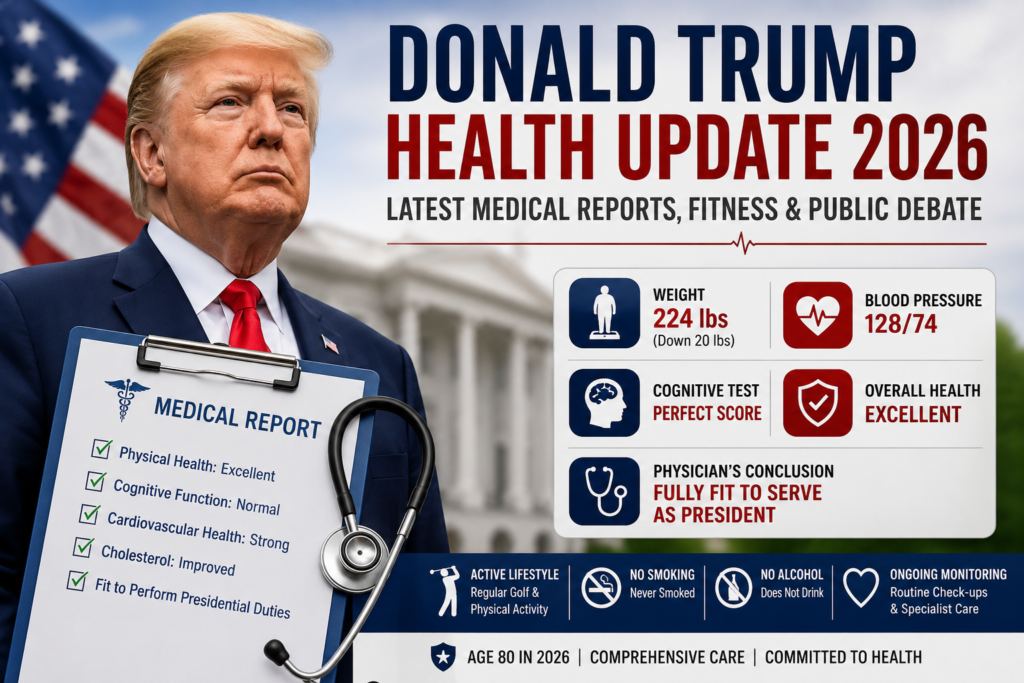
The physician’s findings described robust cardiovascular, pulmonary, neurological, and general physical function. Trump was reported to weigh 224 pounds, approximately 20 pounds lighter than previous assessments from several years earlier. Medical evaluations also showed improvements in cholesterol levels, which physicians attributed in part to medication and ongoing monitoring.
Another notable aspect of the report was the emphasis on cognitive performance. Trump reportedly completed cognitive screening tests successfully, with physicians stating that no signs of cognitive impairment, depression, or anxiety were detected during the examination. These findings became a significant talking point because concerns regarding age and cognitive function have increasingly become part of political discussions surrounding older elected officials.
Subsequent medical updates released during 2025 and 2026 continued to describe Trump as being in excellent health. Although routine age-related conditions were identified, physicians repeatedly indicated that none of these issues interfered with his ability to perform presidential duties.
Physical Health Indicators: Donald Trump Health in 2026
Physical health metrics provide one of the clearest ways to evaluate overall wellness. In Trump’s case, several indicators have attracted attention, including body weight, blood pressure, cholesterol levels, and cardiovascular health. According to the 2025 medical report, Trump’s blood pressure measured 128/74, while his resting heart rate was recorded at 62 beats per minute. These figures generally fall within healthy ranges for a man of his age.
A particularly significant development was the improvement in cholesterol levels. Reports indicated that his LDL cholesterol, often called “bad cholesterol,” had declined to an optimal range compared with previous assessments. Physicians attributed this improvement to medications including rosuvastatin and ezetimibe, which are commonly prescribed to manage cholesterol and reduce cardiovascular risk.
The White House physician also highlighted Trump’s active lifestyle. Although presidential duties are often viewed as sedentary, the report noted frequent travel, public appearances, meetings, and recreational golf activities. These activities may contribute to maintaining mobility and cardiovascular health.
Key Physical Health Metrics: Donald Trump Health in 2026
| Health Indicator | Reported Value |
|---|---|
| Age (2025 Physical) | 78 Years |
| Weight | 224 Pounds |
| Blood Pressure | 128/74 |
| Resting Heart Rate | 62 BPM |
| Cognitive Assessment | Perfect Score |
| Cholesterol Status | Optimal Range |
These measurements suggest that Trump’s overall physical condition compares favorably with many individuals in his age group. However, physicians emphasize that ongoing monitoring remains essential because health risks generally increase with age.
Cognitive Health and Mental Fitness: Donald Trump Health in 2026
Cognitive health has become one of the most discussed aspects of modern presidential politics. Voters increasingly expect transparency regarding memory, reasoning ability, concentration, and decision-making skills. Donald Trump’s physicians reported normal cognitive findings and stated that cognitive assessments revealed no abnormalities. Trump himself publicly emphasized that he achieved a perfect score on cognitive testing.
Supporters frequently point to these test results as evidence that Trump remains mentally sharp and capable of managing the demands of office. They argue that his schedule, public appearances, negotiations, and campaign activities demonstrate high levels of energy and engagement. For many supporters, the physician’s conclusions reinforce their belief that age alone should not determine assessments of leadership ability.
Critics, however, continue to raise questions about mental fitness. Some commentators and outside observers have cited public statements, speeches, and occasional verbal missteps as reasons for concern. These debates often extend beyond medicine into political interpretation, making objective evaluation difficult.
Medical experts generally caution that cognitive screening tests represent only one part of a broader assessment. While a strong test result is reassuring, ongoing observation remains important as individuals age. This reality applies not only to presidents but also to millions of older adults worldwide. The broader lesson is that cognitive health should be evaluated through comprehensive medical assessment rather than isolated public moments.
Medical Conditions Reported Publicly: Donald Trump Health in 2026
Despite generally positive health reports, Trump’s medical evaluations have identified several conditions that physicians continue to monitor. One of the most discussed is chronic venous insufficiency, a common condition among older adults. The condition occurs when veins in the legs have difficulty efficiently returning blood to the heart, sometimes causing swelling or discomfort. According to White House medical updates, diagnostic testing found no evidence of deep vein thrombosis or significant arterial disease.
Another finding involved digestive health. A colonoscopy conducted in 2024 identified diverticulosis and a benign colon polyp. Physicians described the findings as manageable and recommended routine follow-up screening. Such findings are common among older adults and do not necessarily indicate serious illness.
Reports also referenced scarring on Trump’s ear resulting from the assassination attempt in Pennsylvania during 2024. Physicians noted that hearing tests remained normal despite the injury. This information was significant because it represented one of the first detailed medical updates released after the incident.
The overall message from physicians has been consistent: while age-related medical issues exist, none appear severe enough to interfere with Trump’s daily activities or presidential responsibilities. Continued monitoring remains part of standard medical care.
Lifestyle Habits That Influence Trump’s Health: Donald Trump Health in 2026
Lifestyle plays a major role in determining long-term health outcomes. Donald Trump’s habits have often been discussed because they differ from traditional health recommendations in some respects while aligning with them in others. One frequently cited positive factor is his avoidance of alcohol and smoking, both of which are major contributors to chronic disease risk.
Golf remains one of Trump’s most visible forms of exercise. Walking courses, swinging clubs, and spending time outdoors provide physical activity that can benefit cardiovascular health and mobility. Physicians have specifically referenced his active schedule and participation in golf activities when discussing overall fitness.
Diet has also attracted attention over the years. Trump’s preferences for fast food and soft drinks have often been highlighted in media coverage. Yet health outcomes are influenced by many variables, including genetics, medication use, overall calorie intake, and physical activity. Medical reports suggest that weight management and cholesterol control have improved in recent years despite longstanding public discussions about his eating habits.
The combination of regular medical monitoring, cholesterol treatment, and physical activity appears to have contributed positively to his reported health status. For aging adults, this serves as a reminder that health management often involves balancing lifestyle choices with preventive medical care.
Comparing Trump’s Health to Other Presidents: Donald Trump Health in 2026
Comparisons between presidents are inevitable whenever health becomes a major topic. Trump entered office at an age that surpassed many previous presidents. This reality has naturally invited comparisons with leaders such as Ronald Reagan, Dwight Eisenhower, Joe Biden, and George H.W. Bush.
Age alone, however, does not provide a complete picture of health. Medical science recognizes significant differences in how individuals age. Some people remain highly active into their eighties, while others experience serious limitations decades earlier. For this reason, physicians typically focus on measurable health indicators rather than chronological age alone.
Recent reports suggest that Trump continues to undergo extensive evaluations involving multiple medical specialists. Some reports indicate that as many as 22 specialists participated in portions of recent health assessments, reflecting an unusually comprehensive level of monitoring.
Historically, presidential health disclosures have varied considerably. Some presidents released extensive records, while others provided only brief summaries. Trump’s health reports fit within this broader tradition, although debates about transparency continue among journalists, medical experts, and political observers.
Public Perception and Media Coverage: Donald Trump Health in 2026
Public opinion regarding Donald Trump’s health often reflects broader political viewpoints. Supporters generally cite physician reports, cognitive test results, and his energetic public schedule as evidence that he remains capable of serving effectively. They argue that official medical evaluations should carry greater weight than media speculation.
Critics, meanwhile, frequently call for greater transparency. Some observers have questioned the level of detail included in publicly released summaries and have requested additional information regarding medical testing and treatment. Discussions surrounding bruising, leg swelling, and imaging studies have fueled ongoing debate about how much information the public should receive concerning presidential health.
Media coverage amplifies these differences because health stories often intersect with political narratives. Supportive outlets may emphasize positive findings, while critical coverage may focus on unanswered questions. This dynamic makes it challenging for the public to separate medical facts from political interpretation.
The reality likely lies somewhere in between. Official medical reports provide valuable information, but healthy skepticism and independent analysis remain important components of public accountability in democratic societies.
Future Health Considerations: Donald Trump Health in 2026
As Donald Trump approaches and surpasses age 80, health monitoring will likely remain a major topic of public discussion. Aging increases the likelihood of cardiovascular disease, mobility issues, and other medical conditions, making regular evaluations increasingly important. Physicians have already indicated that ongoing screenings and specialist consultations are part of his healthcare routine.
Future health reports may focus on cardiovascular monitoring, cognitive assessments, and management of chronic venous insufficiency. Preventive screenings will continue to play a significant role because early detection can improve outcomes for many age-related conditions. Recent reports of advanced imaging studies and specialist evaluations suggest that a proactive approach is already in place.
The broader lesson extends beyond politics. Trump’s health discussions highlight issues that millions of aging adults face, including preventive care, lifestyle management, cognitive screening, and balancing privacy with transparency. Regardless of political affiliation, these topics resonate because they reflect universal concerns about aging and wellness.
Conclusion
Donald Trump’s health remains one of the most closely watched subjects in American politics. Recent medical reports released by White House physicians have consistently described him as being in excellent physical and cognitive condition, citing healthy cardiovascular indicators, improved cholesterol levels, successful cognitive testing, and an active daily schedule. At the same time, routine age-related conditions such as chronic venous insufficiency and digestive findings continue to receive medical attention and monitoring.
Public debate surrounding his health is unlikely to disappear, especially as he advances in age. Supporters emphasize official medical assessments, while critics call for additional transparency and independent review. What remains clear is that presidential health will continue to be a matter of significant public interest, shaping conversations about leadership, accountability, and the demands of the nation’s highest office.
FAQs
1. What did Donald Trump’s latest health report say?
The most recent publicly released reports described Trump as being in excellent physical and cognitive health and fully capable of performing presidential duties.
2. How old is Donald Trump?
Donald Trump was born on June 14, 1946, making him 80 years old in 2026.
3. Does Donald Trump have any known medical conditions?
Public reports mention chronic venous insufficiency, diverticulosis, a benign colon polyp, and cholesterol management through medication.
4. Has Donald Trump taken a cognitive test?
Yes. According to White House medical reports, Trump completed cognitive screening and reportedly achieved a perfect score.
5. Why is presidential health disclosure important?
Health disclosure helps the public understand whether a president is physically and mentally capable of handling the responsibilities of office, while also promoting transparency and accountability.